AP Is Hard Enough.
Neurodivergent students should not have to take a second, invisible course just to access the first one.
AP classes are supposed to measure advanced academic learning.
But that is not the only thing students are being asked to do.
The system also assumes you can start work without urgency. Estimate time accurately. Hold multi-part directions in working memory. Decide what matters in forty pages of reading. Switch between subjects without losing the thread. Know what “analyze” means without anyone defining the actual move. Build a study schedule months in advance. Recover from a bad week without the whole plan collapsing.
For some students, much of that happens quietly in the background.
For many neurodivergent students, it is a second course.
That is the problem Overbrained was built to solve.
The content is not always the barrier.
A student can understand cellular respiration and still be unable to begin the biology assignment.
They can see exactly what is happening in a rhetorical passage and still lose the point because the connection stayed in their head.
They can understand a novel deeply and see so many possible interpretations that choosing one feels intellectually dishonest.
They can know the material and watch it disappear when working memory fills, the timer starts, or the exam format changes.
Then we tell them:
Manage your time.
Read more carefully.
Stop overthinking.
Stay on top of things.
That is not access.
That is describing the problem back to the student.
The standard system mistakes access for ability.
AP should be rigorous.
We are not interested in making advanced classes easier.
We are interested in making sure the hard part is the advanced thinking.
Spending forty minutes figuring out where an assignment lives is not rigor.
Using panic to manufacture enough urgency to begin is not rigor.
Reading the same paragraph six times because the purpose of the reading was never made visible is not rigor.
Holding six prompt requirements in your head while trying to construct the answer is not rigor.
And measuring all of those things alongside academic knowledge does not magically turn them into measures of intelligence.
Equal expectations do not create equitable access when the route to those expectations assumes one kind of brain.
we built a different kind of AP guide.
Overbrained AP books are written by neurodivergent humans who have actually taken these courses and exams.
We do not begin with the question:
How do we make an ND student behave more like the imaginary student traditional study advice assumes?
We begin with:
Where is the friction?
Then we build the missing structure around it.
That may mean externalizing working memory. Giving vague tasks a visible job. Creating stopping rules for brains that can always see one more thing worth doing. Building restart systems instead of perfect schedules. Separating knowing from showing. Using rubrics as maps. Practicing the actual digital, handwritten, or timed cognitive event instead of pretending format does not matter.
The goal is not to think less.
It is to make more of what you already know accessible, usable, and visible. The general AP guide explicitly frames this as the “course beneath the course”: the planning, initiation, prioritization, retrieval, pacing, and recovery AP students are often expected to supply for themselves.
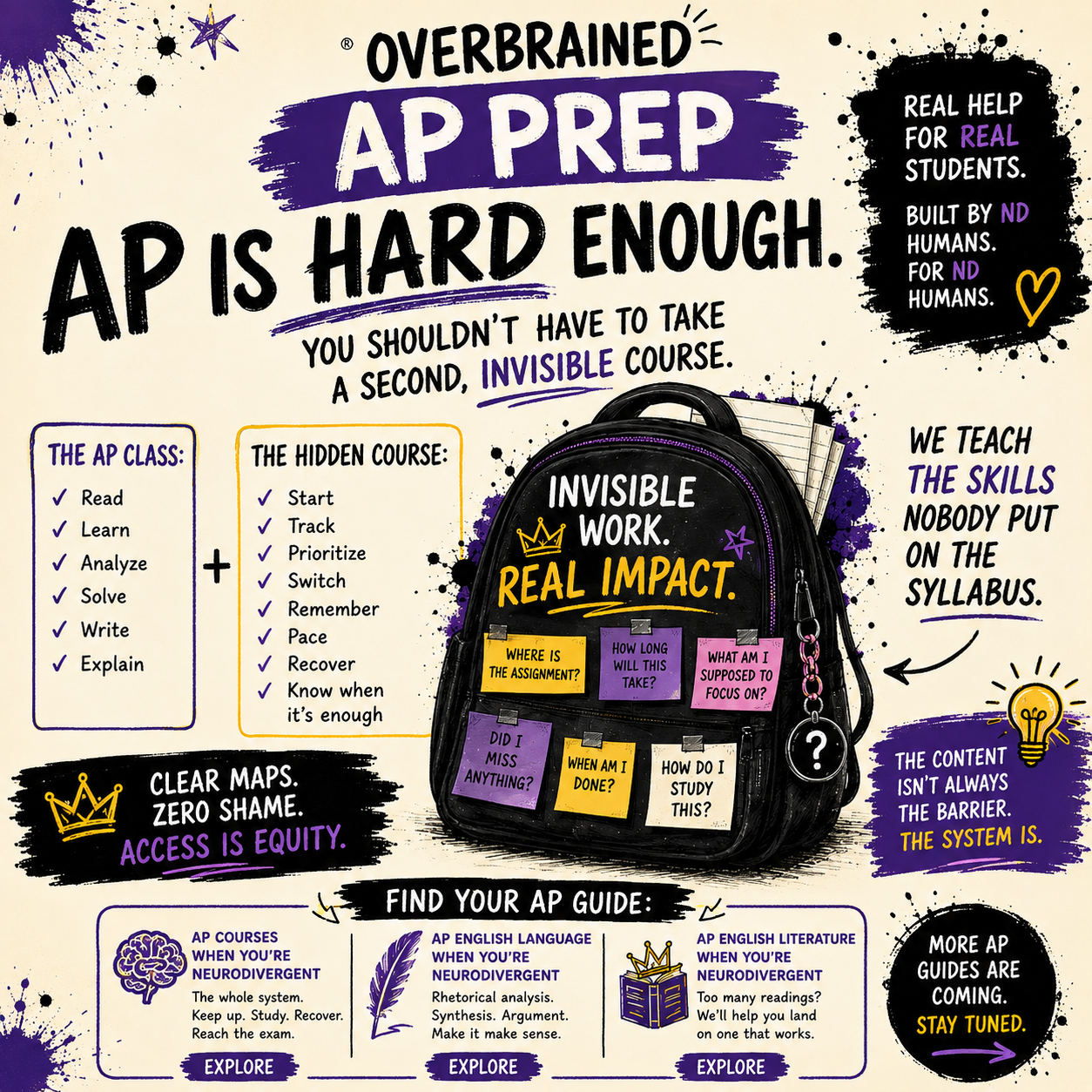
Find Your AP Guide
AP Courses When You’re Neurodivergent
For brains that see too many possible readings at once and need a route from deep interpretation to a defensible, scorable literary argument.
The place to start if the whole AP system is the problem: keeping up, reading, studying, executive function, backlog, pacing, accommodations, recovery, and exam preparation.
AP English Language When You’re Neurodivergent
The place to start if the whole AP system is the problem: keeping up, reading, studying, executive function, backlog, pacing, accommodations, recovery, and exam preparation.