 Image 1 of 1
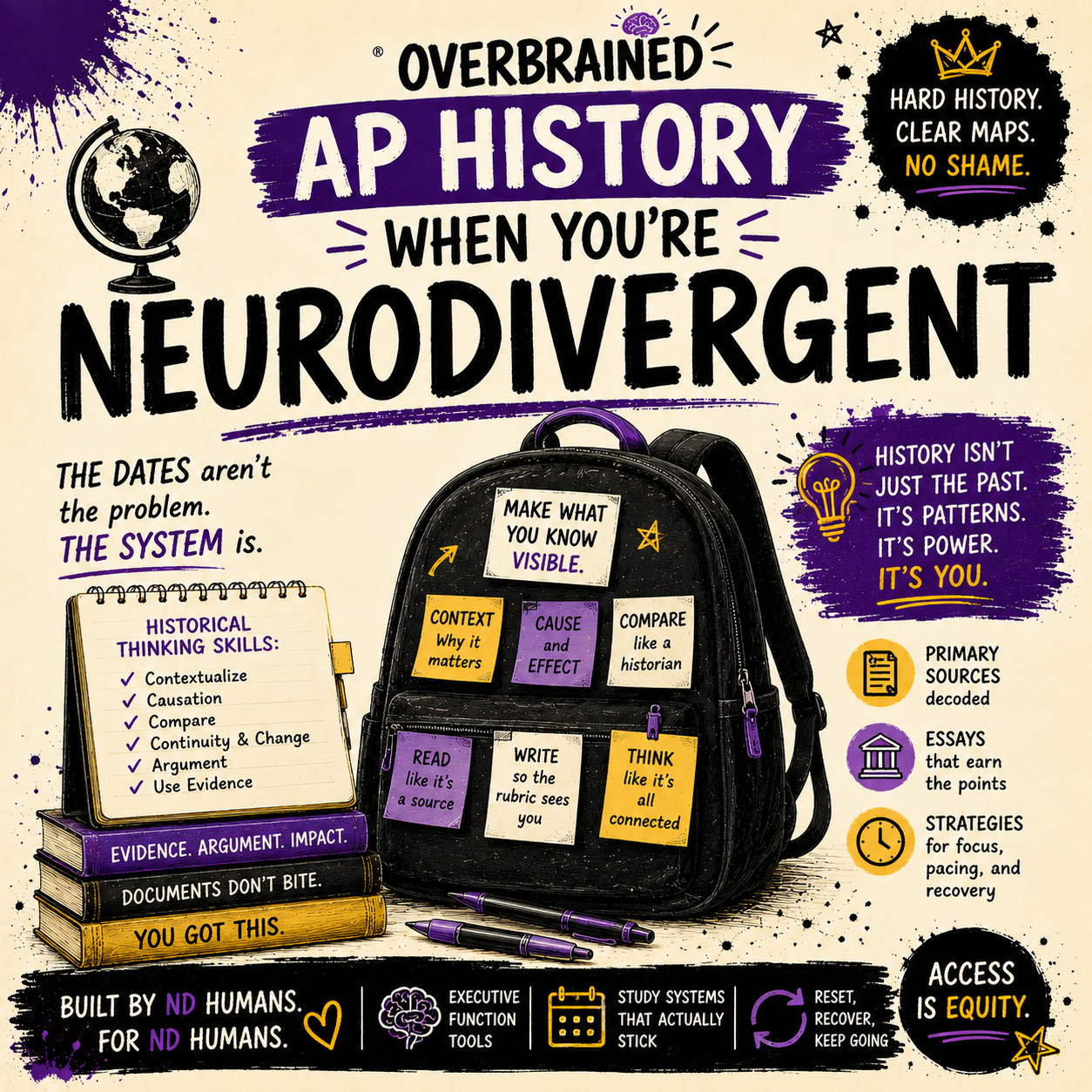
You know the history. Your brain has just misplaced the filing system.
AP History asks you to hold centuries of wars, revolutions, governments, social movements, economic changes, documents, causes, consequences, and people with aggressively memorable facial hair.
Then it gives you a timer and says:
Evaluate the extent.
For neurodivergent students, the problem is often not understanding history. It is figuring out what matters, where to store it, how to retrieve it, and which pieces belong in the answer in front of you.
You may understand an entire historical period but freeze when asked for one piece of evidence.
You may see six possible DBQ arguments when the rubric would really appreciate one.
You may finish twenty pages of reading with seventy highlighted facts and absolutely no idea which twelve mattered.
AP History When You’re Neurodivergent gives you a system for turning all that information into something your brain can actually use.
Built for students navigating AP U.S. History, AP World History, and AP European History, this guide helps you:
organize history around eras, patterns, and relationships instead of isolated facts
recognize causation, comparison, continuity, and change
read primary and secondary sources without getting buried in them
translate AP task words into clear jobs
build evidence banks you can actually retrieve from
approach stimulus-based multiple choice strategically
answer SAQs without writing too little or accidentally composing a dissertation
control the DBQ when seven documents start talking at once
build LEQ arguments without mentally searching an entire century
manage working memory, pacing, studying, accommodations, and recovery
This is not about memorizing more.
It is about giving what you know somewhere to live and a route back out.
Because working-memory capacity is not historical intelligence.
Hard history. Clear maps. No shame.
Access Is Equity.
You know the history. Your brain has just misplaced the filing system.
AP History asks you to hold centuries of wars, revolutions, governments, social movements, economic changes, documents, causes, consequences, and people with aggressively memorable facial hair.
Then it gives you a timer and says:
Evaluate the extent.
For neurodivergent students, the problem is often not understanding history. It is figuring out what matters, where to store it, how to retrieve it, and which pieces belong in the answer in front of you.
You may understand an entire historical period but freeze when asked for one piece of evidence.
You may see six possible DBQ arguments when the rubric would really appreciate one.
You may finish twenty pages of reading with seventy highlighted facts and absolutely no idea which twelve mattered.
AP History When You’re Neurodivergent gives you a system for turning all that information into something your brain can actually use.
Built for students navigating AP U.S. History, AP World History, and AP European History, this guide helps you:
organize history around eras, patterns, and relationships instead of isolated facts
recognize causation, comparison, continuity, and change
read primary and secondary sources without getting buried in them
translate AP task words into clear jobs
build evidence banks you can actually retrieve from
approach stimulus-based multiple choice strategically
answer SAQs without writing too little or accidentally composing a dissertation
control the DBQ when seven documents start talking at once
build LEQ arguments without mentally searching an entire century
manage working memory, pacing, studying, accommodations, and recovery
This is not about memorizing more.
It is about giving what you know somewhere to live and a route back out.
Because working-memory capacity is not historical intelligence.
Hard history. Clear maps. No shame.
Access Is Equity.