 Image 1 of 1
You already know Jekyll is Hyde. Excellent.
Now we can get to the part of the book that actually matters.
Robert Louis Stevenson wrote The Strange Case of Dr. Jekyll and Mr. Hyde as a mystery in 1886.
Unfortunately for Stevenson, cartoons, movies, Halloween costumes, cereal commercials, and approximately 140 years of pop culture ruined the surprise.
So we are not going to make you spend ten chapters pretending you do not know the ending.
The Over-Brained™ Student / Reader Guide tells you the whole story first.
On purpose.
Because knowing what happens is not the same thing as understanding the book.
Your real job is figuring out why Jekyll creates Hyde, why the people around him keep missing evidence sitting directly in front of them, how choice turns into loss of control, and why Jekyll's attempt to separate freedom from responsibility destroys him.
That is the interesting part.
And that is where this guide takes you.
It is short.
The plot is not especially complicated.
And yet plenty of smart readers reach the middle and discover that six Victorian men in dark coats have quietly merged into one enormous Victorian man named Possibly Utterson.
There is a reason. This book asks you to do several things at once. You have to follow old-fashioned prose. Keep similar characters straight. Notice clues. Remember who knows what. Decode conversations where respectable gentlemen would apparently rather walk directly into the Thames than say what they actually mean. Track symbols. Hold unanswered questions for several chapters. And then recognize that the last two chapters are retelling events you already saw from completely different perspectives.
That is a lot of simultaneous processing.
Especially if your brain already spends plenty of energy on working memory, attention shifts, reading fluency, language processing, task initiation, or figuring out the social subtext everyone else seems to think came preinstalled.
So this guide takes some of that load out of your head and puts it on the page.
Before Chapter 1, you get Jekyll and Hyde in six beats.
The door.
The bizarre will.
The murder.
The clues.
The locked laboratory.
The truth.
No spoiler panic. No "but students need to discover it themselves." You already know the twist. Knowing the plot gives your brain somewhere to put the details when they arrive.
Now you can read for the why.
Inside the guide you'll find:
The Whole Book First, so you are oriented before you start
A 60-Second Setup covering when, where, who, and what actually matters
A clear causal chain from Jekyll's original desire to the final collapse
A Character Decoder for the six people you actually need to keep straight
A Theme Decoder translating things like "duality," "repression," "reputation," and "the divided self" into actual arguments
The complete No-BS Plot Map, chapter by chapter
Decoder Cards that separate:
what happened
what a character thinks happened
what was actually true
A Symbol Decoder for the doors, fog, cane, mirror, handwriting, and divided spaces
What Your Teacher Probably Wants You to Notice
Six Essay Angles That Don't Suck
Thesis starters that move you past "everyone has a good side and a bad side"
Quote and evidence support
Annotation guidance that does not require fourteen highlighters and a minor in stationery
An executive-function reading plan
ADHD Brain Notes
Autistic Reader Notes
ND Reader Notes where the book may resonate personally
A complete I'm Lost / Recovery route for when your brain drops the thread
You do not have to restart the book. Seriously. Lost in the plot? Go to the chapter you are currently reading and re-enter there.
The conversation makes no sense?
Ask one question: What is this gentleman refusing to say?
Forgot the twist halfway through the mystery? Anchor on the one thing that never changes: Jekyll and Hyde are the same person. The characters just do not know it yet.
Cannot start? Read the chapter map first. Set a ten-minute timer. Decide where you are stopping before you begin.
Two minutes counts as starting. The goal is not to create a perfect reading streak.
The goal is to make it possible to come back.
Over-Brained assumes you are capable of sophisticated literary thinking.
We also assume you should not have to spend all of your cognitive energy figuring out where you are, what matters, what everyone is implying, what your teacher wants, and how to get back in after you missed three pages.
So we externalize those things.
That leaves more brain available for the actual literature.
Students with ADHD who lose the chain halfway through a chapter. Autistic students tired of being told to "read between the lines" without anyone identifying what is between them. Dyslexic students who understand the ideas but burn enormous energy getting through dense print. 2e students whose analysis runs six steps ahead while task initiation remains parked in the driveway.
Students who use audiobooks.
Students who need to know what happens before they can understand why it matters.
Students who have ever stared at an English assignment and thought:
I know I have thoughts about this. I just have no idea what they want me to do with them.
That is exactly what this guide is built for.
Most study guides hand you more notes.
We hand you the map.
Because the problem is often not that you need more information.
You need to know:
Where am I?
What just changed?
What matters?
What am I supposed to do with it?
And how do I get back in if I lose the thread?
Once those questions are answered, the literature gets a lot more interesting.
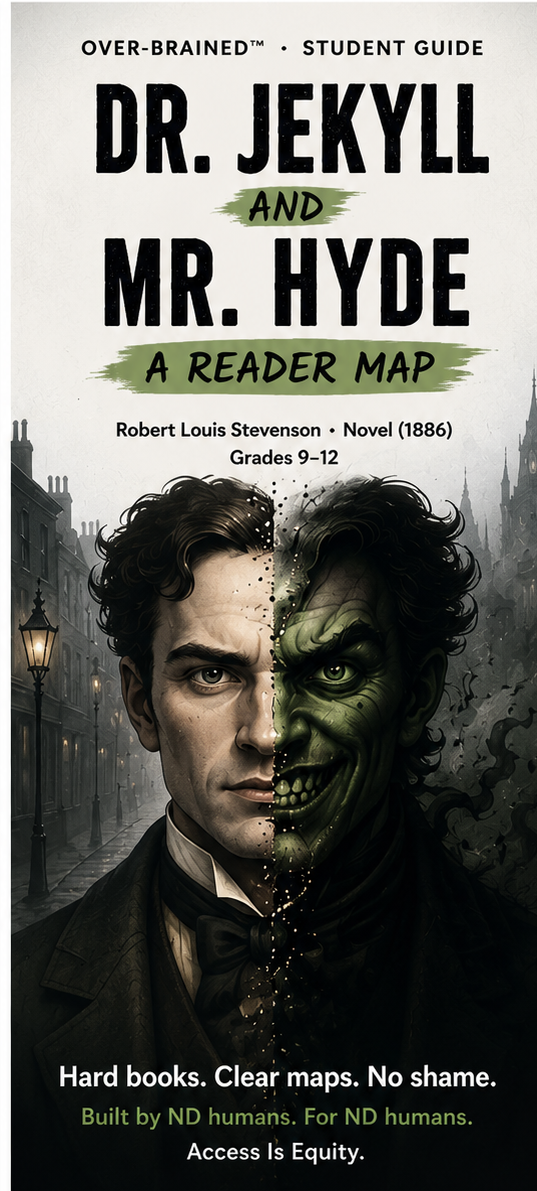
Hard books. Clear maps. No shame.
Built by ND humans, for ND humans.
Access Is Equity.
You already know Jekyll is Hyde. Excellent.
Now we can get to the part of the book that actually matters.
Robert Louis Stevenson wrote The Strange Case of Dr. Jekyll and Mr. Hyde as a mystery in 1886.
Unfortunately for Stevenson, cartoons, movies, Halloween costumes, cereal commercials, and approximately 140 years of pop culture ruined the surprise.
So we are not going to make you spend ten chapters pretending you do not know the ending.
The Over-Brained™ Student / Reader Guide tells you the whole story first.
On purpose.
Because knowing what happens is not the same thing as understanding the book.
Your real job is figuring out why Jekyll creates Hyde, why the people around him keep missing evidence sitting directly in front of them, how choice turns into loss of control, and why Jekyll's attempt to separate freedom from responsibility destroys him.
That is the interesting part.
And that is where this guide takes you.
It is short.
The plot is not especially complicated.
And yet plenty of smart readers reach the middle and discover that six Victorian men in dark coats have quietly merged into one enormous Victorian man named Possibly Utterson.
There is a reason. This book asks you to do several things at once. You have to follow old-fashioned prose. Keep similar characters straight. Notice clues. Remember who knows what. Decode conversations where respectable gentlemen would apparently rather walk directly into the Thames than say what they actually mean. Track symbols. Hold unanswered questions for several chapters. And then recognize that the last two chapters are retelling events you already saw from completely different perspectives.
That is a lot of simultaneous processing.
Especially if your brain already spends plenty of energy on working memory, attention shifts, reading fluency, language processing, task initiation, or figuring out the social subtext everyone else seems to think came preinstalled.
So this guide takes some of that load out of your head and puts it on the page.
Before Chapter 1, you get Jekyll and Hyde in six beats.
The door.
The bizarre will.
The murder.
The clues.
The locked laboratory.
The truth.
No spoiler panic. No "but students need to discover it themselves." You already know the twist. Knowing the plot gives your brain somewhere to put the details when they arrive.
Now you can read for the why.
Inside the guide you'll find:
The Whole Book First, so you are oriented before you start
A 60-Second Setup covering when, where, who, and what actually matters
A clear causal chain from Jekyll's original desire to the final collapse
A Character Decoder for the six people you actually need to keep straight
A Theme Decoder translating things like "duality," "repression," "reputation," and "the divided self" into actual arguments
The complete No-BS Plot Map, chapter by chapter
Decoder Cards that separate:
what happened
what a character thinks happened
what was actually true
A Symbol Decoder for the doors, fog, cane, mirror, handwriting, and divided spaces
What Your Teacher Probably Wants You to Notice
Six Essay Angles That Don't Suck
Thesis starters that move you past "everyone has a good side and a bad side"
Quote and evidence support
Annotation guidance that does not require fourteen highlighters and a minor in stationery
An executive-function reading plan
ADHD Brain Notes
Autistic Reader Notes
ND Reader Notes where the book may resonate personally
A complete I'm Lost / Recovery route for when your brain drops the thread
You do not have to restart the book. Seriously. Lost in the plot? Go to the chapter you are currently reading and re-enter there.
The conversation makes no sense?
Ask one question: What is this gentleman refusing to say?
Forgot the twist halfway through the mystery? Anchor on the one thing that never changes: Jekyll and Hyde are the same person. The characters just do not know it yet.
Cannot start? Read the chapter map first. Set a ten-minute timer. Decide where you are stopping before you begin.
Two minutes counts as starting. The goal is not to create a perfect reading streak.
The goal is to make it possible to come back.
Over-Brained assumes you are capable of sophisticated literary thinking.
We also assume you should not have to spend all of your cognitive energy figuring out where you are, what matters, what everyone is implying, what your teacher wants, and how to get back in after you missed three pages.
So we externalize those things.
That leaves more brain available for the actual literature.
Students with ADHD who lose the chain halfway through a chapter. Autistic students tired of being told to "read between the lines" without anyone identifying what is between them. Dyslexic students who understand the ideas but burn enormous energy getting through dense print. 2e students whose analysis runs six steps ahead while task initiation remains parked in the driveway.
Students who use audiobooks.
Students who need to know what happens before they can understand why it matters.
Students who have ever stared at an English assignment and thought:
I know I have thoughts about this. I just have no idea what they want me to do with them.
That is exactly what this guide is built for.
Most study guides hand you more notes.
We hand you the map.
Because the problem is often not that you need more information.
You need to know:
Where am I?
What just changed?
What matters?
What am I supposed to do with it?
And how do I get back in if I lose the thread?
Once those questions are answered, the literature gets a lot more interesting.
Hard books. Clear maps. No shame.
Built by ND humans, for ND humans.
Access Is Equity.